by Maestro Ramón Martínez
The Spanish School of Swordsmanship, "La Destreza," is the most misunderstood subject in the history of fencing. It has been misrepresented by fencing scholars for the past one hundred years as an ineffectual and artificial system of swordsmanship full of absurdities. The intent of this article and others to follow is to present a clearer and more accurate picture of what "La Destreza" is.
The principal obstacles to the comprehension of La Destreza are the geometry and philosophy that are the foundations of the school. These two aspects have been ridiculed and completely dismissed as totally incompatible with training for the practical management of the arma blanca (white arm). It is of vital importance to approach the treatises of the Spanish Masters with an understanding that these men were highly educated individuals. They bring to their writings a wealth of mathematical and scientific knowledge along with a philosophy replete with mystical thought. It is presumptuous and non-productive of fencing historians to dismiss the complex frame of reference from which this system was derived. The focus of this article will be to present the geometry in a more comprehensible form.
"La Destreza" can not be translated literally but can be interpreted as "high level art and skill." Don Jeronimo de Carranza is considered the father of the Spanish School and given the title "El Primer Inventor de La Sciencia de Las Armas" ("The First Inventor of the Science of Arms") by Don Luis Pacheco de Narvaez. He is referred to by this title not only by his students but by countless other masters as well. Carranza himself clearly states that he is the creator of this school. His teachings were carried on by his disciple and successor, Narvaez.
It was the belief of both Carranza and Narvaez, as well as all of the subsequent masters of the Spanish School, that science, which is irrefutable, can and must be applied to swordsmanship. Their aim was to use science to improve the art of the sword,thus proving the validity, effectiveness, and perfection of their system. The definition of science must be taken into account before continuing. Science is knowledge, as of general truths or particular facts, obtained and shown to be correct by accurate observation and thinking. The science of geometry is the best manner in which "La Destreza" can be set forth because it is incontestable, being demonstrated to be exact by proofs.
During this time period there was an interest in all things that were of classical origin. The science of mathematics, a major part of classical thought, was thoroughly studied in Spain during the intellectual movements towards humanism. "One of the most important of the great methodological achievements of the early Greek mathematicians was the development of the methods of analysis and synthesis, for these methods constitute the basic inferential procedure of Greek geometry. Analysis, according to the Greeks, commences with the assumption of what is to be proved and then proceeds backward by successive inferences to theorems or axioms or postulates generally accepted or previously proved. Synthesis is, of course, the reversal of this procedure, starting with the previously accepted or proved theorem and proceeding therefrom to the proof of the new theorem."[1] This way of thinking is clearly evident in Narvaez’ use of the phrase, "conocimiento de la cosa por su causa" (understanding of the effect by its cause).
The question arises: What is the purpose of the study and application of geometry to swordsmanship? The importance and relevance can be seen in the study of geometry itself. From a text book on geometry;
"Plane geometry as usually taught has several primary objectives. The most important are: (1) to develop an understanding of the meaning and nature of mathematical proof; (2) to improve the quality of thinking in non-mathematical situations; (3) to further develop mathematical concepts of an arithmetic and algebraic nature; and (4) to provide an understanding of plane and space relationships for a better appreciation of nature and the arts as they apply to daily life."[2]
Of particular relevance to the study of La Destreza are points two and four. Point two is key to training the swordsman to achieve a manner of thinking that will aid him in analyzing a given combative situation and act upon the circumstance in a logical manner. Geometry was used to train the swordsman to think logically, methodically, and unemotionally. It enabled the swordsman to develop a coolness and detachment necessary for the implementation of this scientific method. Point four is applicable to generalship as will be discussed later in this article.
In reference to the geometry of swordsmanship in "La Destreza" Don Luis Pacheco de Narvaez states; "Finalmente quiero que entedays, que el fin de poner La Destreza en demonstraciones, es para que procedays con mas conocimiento." (Finally, I wish you to comprehend that the end to which La Destreza is placed in demonstrations (proofs) is in order that one may proceed with more understanding.) What does Narvaez mean by this? Narvaez is clearly stating that the geometric proofs are set forth to enable the swordsman to see how the placements of the body, arm or sword are most effective in relationship to adversary's body, arm or sword. The proofs show how movement can be applied efficiently. When this is transferred into practical application the swordsman can proceed with conviction in the resulting success of the technique.
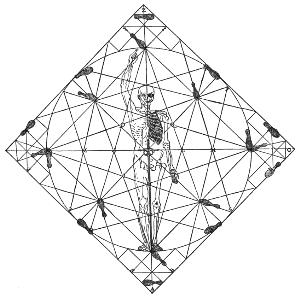
The stance, attack and defence, are all within a circular concept. All fighting takes place within an imaginary circle on the ground. According to Girard Thibault in his treatise Academie de l'Espee (1628), the circle's diameter is determined by the length of the swordsman standing straight with his heels together having his arm and index finger extended over his head. The distance from the ground to the tip of his extended index finger is the diameter of the circle. According to Carranza and Narvaez, the "Diestro" as the swordsmen are called, assume an upright, semi-profiled posture with the heels slightly apart. The arm is held straight forward at shoulder level holding the sword with its blade parallel to the ground and menacing the adversary. The points of the swords are held in front of each other’s sword hilt. This is what determined the diameter of the circle.

Fig. 1: Thibault's circle

Fig. 2 (foreground): Guard position from Thibault's treatise

Fig. 3: Guard position from Narvaez' treatise
The supreme error that has been committed by modern fencing historians is to assume that the demonstrations in the treatises of the Spanish Masters were to be subscribed to literally in a combative situation. It is ridiculous to imagine that Spanish swordsmen stopped an armed confrontation, carefully measured a circle on the ground and then began the fight! Equally absurd would be the idea that a swordsman in those circumstances would ponder if he was properly stepping from point A on the circle to point B across chord AB of the circle.
Another erroneous assumption propagated by many fencing historians that needs to be corrected is their assertion that the circle is in a fixed location. The imaginary circle moves with the swordsmen as they engage in combat. La Destreza is fought in dynamic movement within the circle. The circumference of the circle is in the consciousness of the Diestro. It is well etched in the thought processes after years of theoretical and practical study.
Unlike other systems of swordsmanship La Destreza is based on movement and not solely on technique. What is meant by movement is specific actions of the weapon and body. Each technique (treta) in La Destreza is formed by a combination of movements that compose the technique. As in dancing each step is learned separately, and when performed there are enumerable combinations that create the dance. So it is in Spanish swordsmanship; the varied combinations of movements create techniques (tretas).
The contemporary Italian schools of swordsmanship focused mainly on set techniques. There are a variety of "Guards" that are merely static postures from which to launch an offensive or counter offensive action. The later modern fencing definition for the term "Guard" does not apply here, as these 16th-century positions did not guard the swordsman at all.

Fig. 4: Guard positions from Marozzo

Fig. 5: Guard positions from Vigianni
(It was not until the beginning of the seventeenth century that the concept of a position that actually "Guarded" the swordsman emerged in the writings of Ridolfo Capo Ferro in his treatise Gran Simulacro... (1610).)

Fig. 6: Guard position from Capo Ferro
The swordsman will shift from one posture to another, looking for an opening in the adversary's defense or seizing an opportunity for an attack as the adversary is changing postures. The swordsman will also attack into an oncoming attack while closing the line of attack (time hits), also known as stesso tempo where the parry and the attack become one. In contrast La Destreza has only one posture, which is truly a defensive stance. A stance that keeps the adversary at bay by a continual threat with the sword's point is defensive. It creates a strategic problem for the adversary who must penetrate that line of defense to be able to attack effectively and do it with out injury to himself. An attack will not be met by a counter-attack as in the Italian Schools, but will be answered by moving to a defensive position while at the same time controlling the adversary's weapon with the Diestro’s own weapon. This would seem to be the same as in the Italian Schools but it is not quite. The difference being that the Diestro secures his defensive position by moving away from an attack rather than attacking into an attack. It is similar to the manner in which a bullfighter deals with the attacking bull. As the animal attacks the bullfighter veers away at an angle, steps around from the onslaught, and thrusts the "banderillas" (long decorated darts) or "estoque" (sword) into the bull in one fluid sequence of movements that constitute this particular technique. To put it in simplistic terms, Italian swordsmen see that the best defense is counter attack into the oncoming attack.

Fig. 7: Stesso tempo from Fabris
(Salvator Fabris in his treatise of 1606, De lo Schermo... advises that the only sure manner in which to fight is to meet your adversary's body at the same time it comes forward.) Spanish swordsmen see that the best defense is not to move their body into the path of the attack but to move the body away and shift their weapon towards the oncoming weapon thus covering the line of attack by engagement, opposition or simply placing their sword in a manner to cover the line of attack.
Another difference between the Italian schools and the Spanish school is in the management of the weapon. In the Italian schools, techniques such as cuts or thrusts are classified by the direction from which they travel such as diagonal cuts (squalembrato), downward cuts (fendente), descending thrusts (imbrocatta), and upward thrusts (stocatta). In La Destreza cuts are classified by the type of movement executed by the swordsman and not from the direction that they travel. These are from the shoulder (arrebatar), elbow (medio tajo), wrist (mandoble). Thrusts (esotcadas) are not classified. They are executed from all angles depending on the placement of the weapon and the swordsman's body in relation to the adversary. In the defensive manipulation of the weapon itself there is also a marked contrast. In the Italian schools defensive techniques (parries) are never clearly defined, but are apparently intended to obstruct or block the attack. La Destreza has always clearly defined the defensive techniques with the weapon as a redirection or rerouting of the offensive weapon by the placement of the Diestro's weapon against the adversary's. The positions are not fixed or numerically designated. They can be applied in an infinite variety of ways. All that is required is to make contact on the adversary's blade with the strong part of the Diestro's blade and sword guard. This technique is called Desvio.

Fig. 8: Desvio
Spanish swordsmen attack and defend by stepping around each other (Compases) along the circumference of the circle. The swordsmen attempt to create an opening in each other’s defence by varied changes to the rhythm, tempo, and distance. They attack or defend by stepping, passing, or crossing the circle at angles to each other using chords. Diestros never do this in a linear manner directly at each other. Given their stance, the outcome of impalement by attacking on the diameter would be unavoidable. Narvaez states, "Por la linea del diametro no se puede caminar sin peligro." (Along the line of the diameter one can not walk without peril.)
All attacks, either by cut or thrust, are always executed at an angle to the adversary on either side of the opposing blade. The chords of the circle indicate the angles from which both offensive actions and defensive positioning are the most efficient. The swordsman does not predict the adversary's response. The responses are set up and caused by strategic movement as Narvaez states, "ganando los grados al perfil" (literally, gaining the degrees on the profile, i.e., finding the best position for an attack). This is accomplished by sophisticated footwork which is essential to the mastery of the generalship required in applying the geometry with deadly effectiveness. Narvaez's term for this generalship is "Llave y gobierno de La Destreza" (Key and government of destreza). If the Diestro has accomplished a high level of skill he will be able to command the movements of his adversary by the subtle movements and positioning of his own body. By leading his adversary in this manner the Diestro will be able to create the appropriate angle to launch an offensive action at a moment where his adversary is in a vulnerable position.
The geometry is not solely limited to the illustration and explanation of the spatial relationship between the adversaries. It also applies to the movements and positioning of the weapons. In all of the Spanish treatises it is constantly emphasized that the control of the opposing weapon must be maintained by "atajo" (the taking control of the adversary's blade with one's own, an engagement or opposition).

Fig. 9 (foreground): Atajo
The ability to achieve the atajo is acquired by the Diestro cultivating what was called "tacto" by the Spanish Masters. Tacto can be best described as the tactile feeling sensed in the hand of the swordsman while holding his weapon. This tacto is what enables the Diestro to read the strengths, weaknesses, and intentions of his adversary, on blade contact. (Tacto is in fact the same as the French term "Sentiment du Fer" used in smallsword and foil technique.) In order to achieve this atajo the controlling blade must be placed against the opposed blade at the most efficient position which would ensure the maximum leverage and mechanical advantage. This would be determined by the Diestro's knowledge and application of angles. As Carranza states, "El conoscimeinto que se adquiere con el uso . . . ." (the understanding that is acquired by use) and "Del uso nase el conoscimeinto" (From use comes the birth of understanding). This geometric conceptualization is also applied to the movements of the weapon and how they are executed by the Diestro. If the Diestro raises his sword to make a downward cut, the obtuseness of the angle is determined by the distance and positioning of the adversary as well as the intended target for the cut. The angle of the defending weapon in a counter-offensive action is determined by the angle of the attacking weapon. If the attack is coming towards the head of the Diestro, he can deflect or reroute the attack by raising his weapon to cover the attack while simultaneously offending his adversary with the point of his sword. The knowledge of angles also applies to defensive actions such as Desvio (deflect, parry; literally, to change course). To execute an efficient Desvio the Diestro must place his blade against his adversary's blade in such a manner as to not only deflect the attack but to enable him to counter attack in the same movement. This can only be done correctly if the Diestro has an understanding of angles and the different mechanical advantages achieved by the placement of his blade on the adversary's blade.

Fig. 10: Desvio
When one is learning a system of fencing or any other martial art, it must be done in a logical progression. It has to be practiced by rote, or "by the numbers". It is with this type of training, that the mind and body are focused and tuned to be able to use the method in applications to the never ending variety of circumstances that can occur in a physical conflict. In no way can every changing situation be predicted in the course of combat. However if the mind and body are trained to size up a situation and react in a logical manner the chances of victory along with survival are increased many times over. This precludes reacting in an uncouth illogical manner derived from the desperation of self preservation. Carranza said: "The vulgar (fencer), although he professes knowledge of swordsmanship, is easy to discover when in times of anger and conflict he forgets his professed skill, committing vulgarity in his manner and action." Carranza also warns that: "If the skill of the swordsman is ‘invented’ the swordsman in a time of danger is forsaken by his false skill."
The Spanish School has been structured, formal, and uniformly systematized throughout its history. In Italian fencing of the same era there is not a singular "school" but "schools" of swordsmanship all differing in regard to master, city, and region (which persisted into the 20th century). The Italian treatises deal mainly with classification and collections of certain types of attacks (bottas). Consequently the Italian treatises in comparison are much less difficult to understand. The Italian Schools have a more physical (external reactive) approach incontrast to the Spanish which is more conceptual (internal analytical).
The difficulty in understanding La Destreza is that it is a complete system with many levels. It encompasses Science, Art, Experience, Philosophy and Spirituality. These crucial elements can not be viewed out of context, otherwise the entire essence of La Destreza will be lost. The mind set, character, culture, religious, philosophical, and political aspects from which La Destreza emerged must be taken into account. La Destreza is the equal of any of the sophisticated oriental martial arts (along with their socio-cultural aspects) that occidentals have embraced with such awe and reverence. The two main aspects of La Destreza, geometry and philosophy, produce a unique and vastly different manner of thinking creating a cold, calculating swordsman. In any martial art a fighter possessed of these atributes is a formidable force to contend with.
It must be concluded that the manner in which La Destreza has been interpreted by fencing scholars is unjustified. There is absolutely no "mystery" in the Spanish School of Swordsmanship. Nor are there any fantastic, absurd, or arrogant pronouncements on the part of the enlightened individuals that were the founders of the system. More to the point, the questions that must be asked are:
The readers of this all too condensed and limited presentation will hopefully assume a fresh vantage point in the observation of La Destreza and begin to see through the clouds of myths that obscure the full understanding of the system of the management of the "Espada Ropera."
[1] Clagett, Marshall. Greek Science in Antiquity (Barnes & Noble, 1994) p.53.
[2] Schacht, John F. and Roderick C. McLennan. Plane Geometry (Henry Holt & Co., 1957) p.v.
1. Clagett, Marshall. Greek Science in Antiquity. Barnes & Noble Books, 1994.
2. Capo Ferro, Ridolfo. Gran Simulacro... . Sienna, 1610.
3. Carranza, Don Jeronimo. De la Filosofia de las Armas.... Seville, 1569 -1582.
4. Fabris, Salvator. De lo Schermo, overo scienza d'arme... . Copenhagen, 1606.
5. Narvaez, Don Luis Pacheco de. Libro de las Grandezas de la Espada... . Madrid, 1600.
6. Schacht, John F. and Mclennan, Roderick C. Plane Geometry. Henry Holt and Comapny, Inc., 1957.
7. Girard Thibault in his treatise Academie de l'Espee.... Leyden, 1628.
8. Achille Marozzo. Opera Nova. Venice, 1550.
9. Angelo Viggiani. Lo Schermo. Venice, 1575.
One of the most important aspects of La Destreza is the concept of "angular attack and defence." As was presented in the first article, the two swordsmen assume their stance (Afirmarse) at opposite ends of the diameter of an imaginary circle, each with their sword arm extended and the point of the weapon continually threatening their adversary. The problem that each diestro now faces is how to penetrate that line of defense without being wounded himself. Any attack or defense executed straight at the adversary would, for all intents and purposes, be suicidal. This problem is solved by the use of "angular attack and defense."
In order to accomplish this end, the diestro must move off the diameter of the circle and place himself at an angle to his adversary. In so doing, he simultaneously creates a threat to his adversary and removes himself to a position where he is relatively safe. The other diestro now finds himself at a disadvantage because, no longer presenting a counter-threat, he is open to attack. However, since both swordsmen are seeking the advantage, he will not remain passive, but rather, as soon as he observes his adversary move to a threatening position, will seek to counter his intention. In this lies the paradox: How does one move to create an angle of attack without being thwarted?
This question is not a simple one to answer. If both adversaries remain still and passive, there will, naturally, be no advantage and no disadvantage. The solution to the problem is generalship. Generalship is command of timing, distance, space, and movement. It is one of the most important aspects of La Destreza, and, for that matter, of any martial art.
One of the central concepts to the understanding of La Destreza is the concept of Movimientos (Movements). These are classifications of specific, isolated actions of the body or weapon. Carranza divided the actions of swordsmen engaged in combat into the individual components that comprise a technique (Treta). These movimientos, once learned and mastered, can be performed in innumerable combinations.
Some of the movimientos are:
Violento: A sudden upward movement of the sword.
Natural: A deliberate downward movement of the sword.
Remisso: A retraction of the sword to either side which precedes another action.
Mixto: A combination of movimientos done to either side taking and maintaining control of the adversary's sword with one's own sword.
Along with movimientos, the diestro learns specific footwork. Compases is the general term for the walking steps that diestros execute as they walk about the circumference of the imaginary circle. These steps are also classified.
Some examples are:
Passo: A step covering the distance from the center of the heels when one foot is moved and not the other.
Passo en su simplicidad: A step done by either of the feet.
Passos en genero: Steps that are done alternately walking.
Passos mas perfectos: A term for those steps in which the body is considered to be solid, strong and graceful.
Footwork must be performed in a fluid manner, varying according to the intention of the diestro. It is important for the swordsman not to be double-weighted; The only time that there is equal weight distribution is in the beginning stance before the compases are begun. This is where the art of generalship comes into play. While manipulating timing, distance, space and movement, both diestros must be able to instantly size up a situation and act in accordance.
As the two swordsmen begin to move about each other, each observes how the other responds. For instance, if diestro A, moving around diestro B, sees that his adversary is not strong in maintaining the diameter (which is the safest location), he may position himself at an angle suitable for launching the most efficient attack. However, is B really weak, or is he attempting to deceive A, setting up a trap by giving false responses? If so, then how does A find out his true intentions?
One way in which A, may determine the truth is by subtle, varied adjustments in his stepping. He may, for instance, walk very slowly, or pick up the pace. He might stop abruptly, and observe if B continues. He might take long or short passos or cross the circle on a chord. Or, he might advance at an acute angle towards B, and then suddenly veer of at a wider angle, to either side of his adversary's blade. Meanwhile, B might not necessarily have been giving true responses, but rather may have a second, or even a third, intention in his combat strategy.
At the same time that all positioning and repositioning is occurring, blade actions are also being performed. Possible actions include taking the blade (Atajo), blade pressures (Tacto), redirection of attacks (Desvios), cuts, and thrusts. The diestro must consider the possibility of each of these when setting up an angular attack.
Each combination of movimientos and passos previously stated comprise a technique (Treta). The following is an example of a treta and an angular attack, though it is only one instance of the innumerable possibilities that can occur:
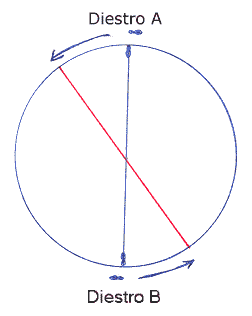
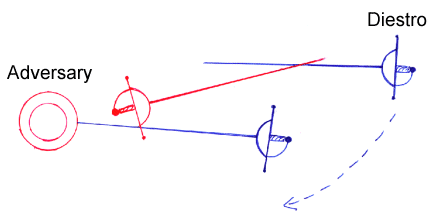
Diestro A performs two passos en genero counterclockwise, to diestro B's left, along the circumference of the circle. Upon arriving at point C, diestro A abruptly halts momentarily and then does a passo across chord CD of the circle, traveling at an angle towards diestro B. His adversary, not perceiving that diestro A had suddenly stopped at point C, continues to move, thus opening the angle for diestro A to engage (atajo) his blade and proceed along chord CD. As he does so, he thrusts, striking diestro B in the face. The angular attack has been successful.
A proper response on the part of diestro B might have been the following:
In order to prevent the attack from landing, B must use his sense of Tacto. He must press back with his blade against A's Atajo by opposing with the strong part of his blade, while simultaneously raising his guard (hilt) and slightly lowering the point of the rapier. It is of vital importance that his opposition be executed edge to edge, and never with the flat of the blade. While performing this opposition, B will also take a small step to his right, thus displacing himself away from the threatening point of A's rapier at a very acute angle. Diestro A would then be hit in the face as a consequence of the forward momentum of his own attack.
In addition to the aforementioned considerations, proper body positioning and alignment are crucial to the correct execution of these procedures. The diestro's bodies must be held in a semi-profiled manner, and they must strive to maintain the diameter of the circle until they execute an offensive, defensive, or counter offensive action. If they were to hold their bodies in an excessively profiled manner, they would not be able to execute the movimientos, footwork, or any other action in an articulated, fluid fashion. Rather, all actions would be stiff and off time.
Likewise, if the diestro is excessively profiled, his options to shift from one place to another will be more limited, since he would not be able to do so without first readjusting his stance. Conversely, if the diestro holds his body in an excessively squared off stance, he will present a large target that will be difficult to defend. Even worse, he would have to shift to a semi-profiled position in order to attack, which could produce excessively large actions and effect the timing.
With regards to footwork in La Destreza, it has been mentioned by certain fencing historians that stepping is performed in a "shuffling" manner. This is an absolutely incorrect perception, and is, in fact, contrary to the deliberate and precise methods of the Spanish School. All steps, compases and passos, of any combination or variety, are executed by the deliberate, accurate placement of the feet. All stepping as was said earlier, is done in fluid motion.
Likewise, contrary to the misapprehensions of fencing historians, thrusts were not delivered in stabbing or jabbing action. In a thrust, the arm is extended and the point is pushed "through" the intended target by the forward momentum of the swordsman's advancing body. The timing of the attack, assisted by the weight of the attackers body behind the weapon, creates the concentrated force that allows the point to penetrate with ease. The swordarm is straight but not locked allowing the force to go out to the point. To hold the rapier with the wrist, elbow, and shoulder locked, like a battering ram is incorrect, and would produce a recoil effect.

Diestros A and B stand at opposite ends of the diameter. To insure a safe position Diestro B responds by moving and maintaining the diameter. Red line is the new diameter.

Diestro A stops at point C while Diestro B continues moving, thus creatingthe opening for Diestro A to attack at an angle. Diestro A steps in at an acute angle along chord CD. Red lines indicate the acute angle.

Diestro A's rapier travels at an even more acute angle toward Diestro B. A’s rapier controls B’s blade by opposition as it travels forward to B's face.

Diestro B raises his guard (hilt) and deviates the point of Diestro A's rapier (desvio). At the same instant B steps slightly to his right and lowers his point toward Diestro A's face. Diestro A impales himself by the force of his own attack.
by Maestro Ramón Martínez
Three Destreza Attacks against the Common Vulgate Fencer
interpreted from the writings of Narvaez
Llave y gobierno de la destreza."
"De una filosofia de las armas."
(1608)
The following three attacks (offensive maneuvers) from La Destreza were taken from the above mentioned treatise. I have broken down the demonstrations of Narvaez into their most common denominator by simplifying the translated Castilian into fencing terminology that is in common usage today. I would have preferred to translate the original text as it appears but since the aim of this series is to demystify I thought it prudent to use language as well as terms that any well trained fencer having a firm technical foundation can comprehend.
The word "vulgate" in the title of this article is the term used by Carranza and Narvaez when they referred to the more common form of swordsmanship practiced during their era.
The following are the demonstrations:
"Tentar" (literally meaning to feel or probe) being a well known form of making blade contact, and a crude form of Engagement, or Legamento.
If your adversary makes contact "tentar" with your sword (engages) by placing his point (punta) against the middle (medio) of your blade, in quarte, or quarta, in order to attack your face, you have three ways in which to wound him: two with curving steps "compases curvos", and the other stepping straight (recto)*.
*The attack is straight, however it is not executed against another Diestro versed in the same Spanish system, but a less trained common swordsman.

When the adversary first makes contact "Tentar" (engages), wound him over his sword.
As the adversary contacts "Tentar" (engages) your blade, side step by using a curving step "compas curvo" to your left, and freeing your sword without bending your arm (disengaging, cavazione). Then by angulation of your wrist strike him by a thrust to the chest over his sword behind his hilt and towards his right side, while simultaneously continuing your circular movement, around him. Do not permit the adversary's sword to meet yours.
You can also answer this prepatory technique at the commencement of your adversary's blade contact "Tentar" (engagement, legamento) by moving in the same manner as previously described, but by an alternative attack under his sword arm. He will attempt to beat your blade away (in seconde, seconda), but your counter attack is by a back edge cut (reves) to the body (flank or lower abdomen) as you continue walking around the adversary.
[Note: In La Destreza cuts are used just as frequently as thrusts. The Spanish Masters were well aware that under certain circumstances that present themselves in actual combative situations, it is more efficient to deliver a cut than a thrust. This will be dealt with in future installments of this series.]

On the adversary making blade contact (tentar), wound him directly in the chest.
[This technique begins at the instant when the foible of the adversary's blade is against the forte of your blade because you have allowed him to reach further along your blade with his own.]
On the adversary's engagement with the "flaqueza" (foible) of his blade against the "fureza" (forte) of your blade, and as he moves to engage, execute a straight thrust by forcefully opposing his blade upward with your own and allowing his blade to fall against your "guarnacion" (hilt, guard) while at the same instant stepping directly at him. If on your executing the above mentioned attack, the adversary responds by lifting his point in order to attack your face, you will counter-respond by slightly lifting up your guard and impeding his attempted counter-offensive action.

If the adversary makes contact "Tentar" (engages) intending to wound you by thrust, oppose his sword.
You can defend yourself and strike your adversary in two ways:
One by forming a cut over his blade. You can execute a cut to the face or upper body, just above his blade at the moment of his contacting yours. [Note: Not a cut over (coupe)] This can be done by taking a half side step if it is convenient.
An alternative response is to permit blade contact, thereby allowing the adversary initiative to move to execute a thrust. When he does this, oppose his blade and counter thrust.
The other manner in which to strike your adversary by thrust is to attack without loosing blade contact or lifting your sword from the adversary's sword. This is done by slightly reaching further with your arm while having your hand in supination. If the timing of your commitment to the action is timely, as a consequence you will also oppose his blade on your action and strike him by thrusting as previously advised.
The maneuvers described in this 17th century treatise would be described today as "attacks on the preparation." These actions require an acute sense of timing, distance, and above all "sentiment du fer" (tacto), in order to be executed correctly and efficiently.
The intention of presenting these three attacks is to open a window for the reader and provide a clearer view of the actual application of the techniques of La Destreza. By taking a "hands on" approach to Spanish Swordsmanship, it can be discovered that there really is no mystery, or magic, in the Spanish School. The only mystery is ignorance of the "how" and "why." The magic is the understanding of the "when."
"How" is the precision of the manner in which something is executed.
"Why" is the reason for which something is executed.
"When" is the correct time at which something is executed.
Principles such as the above mentioned are important to the assimilation of La Destreza. Rather than attempting to learn an infinite variety of separate techniques, the Diestro learns basic principles that can be mastered, adapted, and applied to an infinite number of circumstances The esoteric qualities of La Destreza are found in its philosophy and spiritual aspects which hopefully will be presented in future installments of this series.
by Maestro Ramón Martínez
This paper was delivered on April 9th, 2005 at Cambridge, UK for the Renaissance Society
of America's Annual Meeting.
Don Jeronimo de Carranza was a product of his time. Based on his pupil—and later critic—Don Luis Pacheco de Narvaez’ assertion that Carranza’s 1569 work, de la Filosofia de las Armas y de su Destreza y la Aggression y Defensa Cristiana was completed when Carranza was thirty years old, Carranza was born in Seville in about 1539.[1] His life thus coincided with Spain’s peak as a world power, the Reformation and Counter-Reformation, the great wars of religion, and the ultra-conservative reign of Phillip II. Though Italian humanism and reverence for classical antiquity manifest themselves in Carranza’s writing, the influence of the medieval Scholastic tradition is also present in his work.
One way this conservative spirit manifested itself in the Spain in which Carranza lived and worked was through a glorification of the ethos of chivalry. For instance, Garci Ordóñez de Montalvo’s epic romance Amadis de Gaula was published in 1508 and enjoyed great popularity through Carranza’s lifetime. Carranza’s life and career were marked by chivalric ideals as well. He was of
sufficient noble rank and fame to be named a knight, and then Commander, of the Order for Christ. In 1605, the same year Cervantes published the first book of his Don Quixote, Carranza received an
honorary crown from his native city of Seville. Cervantes himself had nothing but praise for Carranza. In his Song of Calliope, Cervantes holds Carranza up as a gentleman who has struck an equal balance between Apollo and Mars. Spain also sought to spread its culture and the one true Catholic faith) as much as it sought to preserve it, and Carranza was very much an active participant in this. In 1589 he was sent to the New World as governor of Honduras, and (according to Leguina’s Bibliografía), upon his return to Spain, dedicated himself to his studies and religious practice.
What Carranza is best remembered for today, of course, is his book on fencing, de la Filosofia de las Armas y de su Destreza y la Aggression y Defensa Cristiana (“On the Philosophy of Arms and its Skill, and Christian Offense and Defense”). First published in a small print run in 1569 for the unfortunate Duke of Medina-Sidonia, later commander of the Spanish Armada, de la Filosofia de las Armas did not receive wide distribution until its second printing in 1582 in Sanlúcar de Barrameda. In any case, its intended audience, in keeping with Spain’s obsessive concern for rank and blood, was no doubt limited, as it sets out an art explicitly intended to be learned only by the highest nobility. Carranza’s work reflected the concerns of his stratum of society: The “Christian offense and defense” he speaks of is not for soldierly use on the battlefield in one of St. Augustine’s just conflicts between nation-states, but rather, for the use of individual’s personal sidearm to settle private quarrels and for self-defense.[2] (Note, however, that duels were far less frequent in Spain, and far mor prosecuted, than they were in France or Italy.) The weapon Carranza was concerned with was not the knightly sword intended for the battlefield, but the civilian espada ropera, translated as “dress sword” or “sword of the robe”—now termed the rapier—which by the preponderance of evidence seems to have been developed in Spain in the late fifteenth century. (This type of sword, according to A.V.B. Norman, was first referred to in the 1468 post-mortem inventory of the goods of Duke Alvaro de Zuniga.)[3]
De la Filosofia de las Armas is a distillation of the spirits running through Carranza’s society and life: chivalric martial culture, Catholicism, courtly ideals, obsession with rank and purity blood, the will to conquer and exert power, and a love for classical learning—for the most distinguishing characteristic of Carranza’s invention (and the one most perplexing to historians of fencing) is that its principles are explicitly set out in terms derived from Aristotle and Euclid. Rather than following the common methods of fencing of the time, which he termed “esgrima vulgar,” meaning “vulgar fencing” and regarded as haphazard collections of tricks, Carranza sought to devise a scientific approach to swordsmanship. This, he termed la verdadera destreza, which can be loosely translated as “the true art and skill.” Carranza states that he has written his book in order to open the secrets of true swordsmanship, which was, in his opinion, in a poor state in his time, and very carefully goes on to say that in discovering the errors of the esgrima vulgar, what he has accomplished is a reformacion (that is a “reformation”) of swordsmanship, thus creating a nueva sciencia, or “new science.”
Carranza’s work takes the form of four Socratic dialogues, the contents of which he summarizes thusly:
The first dialogue treats of the invention of the art and itsuniversal propositions, where all doubts against destreza are solved and you will see the effects of itsdefinitions.
The second dialogue treats of the false destreza, universally and particularly, where it is discovered the deceits of the commonfencers, and other things that are pleasing to this purpose.
The third dialogue deals with the demonstrations of the techniques that in general were proposed in the first dialogue and shows the universal principles of the dagger against the sword and the judgment of all weapons.
The fourth dialogue treats of natural defense, and how the diestro puts into practice what he has learned, without committing aggression nor committing treachery nor surely dying, and the obligations he has to return to himself, his friends, and his enemies by divine positive and natural right.[4]
While, in reality, diatribes against the errors of the vulgos—the “vulgar fencers”—take up a large part of the text, the remainder Carranza’s treatise, when read and understood in the proper light, is perfectly logical. The Scholasticism that Carranza adhered to did not value superficial knowledge or a command of trivia and tricks; rather, principles, like the laws of logic, were to be abstracted and universalized from experience. No knowledge could be true unless it could be abstracted from coarse material reality. By becoming familiar with these universal principles, one could then apply one’s knowledge to specific individual situations. As Carranza himself states, “The solution to doubt is the invincibility of truth.”
Carranza thus, using Aristotelian and Euclidian analyses of motion, dissects swordsmanship into its component actions, breaking each action one performs in swordsmanship down into its component motions, or movimientos: The types of passos, or steps one can take (straight, lateral, compass, etc.), the types of motions one can make with the sword (cuts from the wrist, elbow, and shoulders, parries or desvios), holding the hand with the fingernails up, down, inside, or outside (uñas abajo, arriba, a dentro, a fuera). The actions one performs when in the interplay of combat are often described in terms taken from Aristotle’s Physics: Raising the arm is violento, for instance, lowering it is natural.
The fact that the sorts of steps Carranza describes were later used by dance masters (for instance in Juan de Esquivel’s 1642 Sobre El Arte del Dancado) has given many the false impression that Carranza is describing some sort of choreography; though the aesthetics of motion are similar—human beings seem to find beautiful the sort of balanced, centered, graceful motion that is most efficient for fighting—destreza has nothing in common with dance choreography. The actual techniques, or tretas, are improvised out of the movimientos in real time in response to the situation one finds oneself in. This analysis also provides a method for training the disciple to perform optimally in a real situation. However, Carranza, beyond defining his terms, does not give elaborate instructions. Rather, the student would be trained in person. Once this understanding and theory of motion was internalized (or so Carranza believed), one’s own ingenuity would then apply it in the proper way according to the situation they found themselves in. As he says in his first dialogue, “…know that everyone’s best master is their own ingenuity, judgment, good diligence and ability…” (“…Sabed que el major Maestro de todos es el ingenio el juyzio la buena diligencia y habilidad de cada uno…”)[5]
To briefly describe la destreza in action, picture two swordsmen standing erect opposite each other, their bodies semi-profiled, sword-arms extended, blades parallel to one another. The length of the blades, Carranza stated, forms the diameter of an imaginary circle.[6] Thus each swordsman walks along the circumference of the circle, keeping his point aimed at his adversary. To attack along the diameter of the circle would be sure death, as the swordsmen would wind up impaling one another. The posture is thus not only offensive, but also defensive: Because both adversaries’ swords are always pointed at the each other in this manner, neither can make a direct attack. However, by using proper footwork to execute an angular attack off the diameter of the circle—while observing the various other requisites of the art, such as distance, timing, proportion and blade leverage—the diestro creates an opening in his adversary’s defense. This strategic positioning, this combative “generalship” (to use a boxing term) is the foundation of Carranza’s invention. “Invention,” indeed, is the proper word, for destreza is structured and explained unlike any other European system of swordsmanship, past or present. This structure derives entirely from the unique intellectual currents that flowed through Carranza’s Spain.
Rather than illustrations that are, at best, static representations of movements frozen in time, Carranza makes his demonstration by geometric diagrams which represent, in an abstract manner, the placement and movement of the combatants. As in navigation, in which knowledge of geometry is paramount, the relative position and movement of the swordsmen can be demonstrated precisely. Carranza’s task in defining la destreza is to show, by geometrical demonstrations, that his method is an exact science; if this can be proven, then the theory, art, and science of his swordsmanship can be shown beyond doubt to be infallible and perfect. As he himself states:
You know that mathematics strips bare the forms and figures and numbers of the material, in which no falsehood is admitted, because it does not dissimulate, either affirming or denying, because it considers things simply and not all together. And it has this privilege more than the other arts in that it declares its intentions with most true demonstrations, for which reason the ancients guided those things they called true and certain arts with this reasoning, and that any truth one has in human affairs lies in mathematics because its teaching is very pointed (that is to say simple); it guides the sciences, whether moral or natural, by the most direct route. . . as is seen in the beginning of the Sextant of Euclid, from whence is born the foundation by which the astronomers verify their calculations which are found most copiously in the Algamest, and whose esteem and importance will be seen the inscription that was in the School of Plato, which said that no one who was ignorant of mathematics could enter inside. This is the reason it seems to me a more certain thing to order la destreza under mathematics rather than any of the other sciences.[7]
In truth, though, theory does not precede practice. In destreza, as for all practical arts, knowledge of what to do precedes theory. Though Carranza states that he developed this method “without a teacher,” he was no autodidact. In truth, he was an experienced swordsman, explaining his art in a scholastic manner, not a philosopher pretending to be a swordsman. As a military man and member of the nobility, he would have been trained in arms since birth. Rather, this is a new method for fencing, based, as he says, on “art, knowledge, science, and experience” is guided by his genio, or “genius.” From his experience and observation of the common methods of swordsmanship of his time and by applying his education in science and philosophy Carranza distilled universal techniques, such as the atajo, or contact with the opposing blade, which he incorporated into la destreza. Demonstrating his knowledge of physics and the concept of leverage, Carranza, as other masters do, divides the sword into degrees from the cross of the hilt to the point of the weapon progressing from the greater numerical value to the lesser. He then goes on to explain that the higher degree must always oppose the lesser degree of the adversary’s sword. Underneath the immense verbiage, the principles Carranza describes are eminently practical and common to all fencing.
So, how was Carranza’s “new science” received? Cervantes, in Chapter 19 of the second part of Don Quixote (1614) presents a skilled swordsman skilled in Carranza’s method humiliating a strong, enraged—but unskilled—adversary. Conversely, Don Francisco de Quevedo y Villegas, in his 1627 Historia de la Vida del Buscón, lambasts what he believes are the absurdities of la destreza, presenting us with the picture of a scholar who is so obsessed with geometry that he can not mount his mule without measuring the acute and obtuse angles and is run off by the first cutthroat who challenges him. (There was a certain amount of bad blood between Quevedo and Carranza’s student Don Luis Pacheco de Narvaez. Quevedo knocked Narvaez’ hat off his head in an encounter that took place in 1608 in the house of the President of Castille. Quevedo had impugned Narvaez’ work in his presence, and so the argument was taken outside and put to the test. The two fought a single pass, resulting in the aforesaid removal of headgear, before their host stopped the matter. They thereafter limited themselves to verbal and legal passes.)
Modern authors have been even more critical. The nineteenth-century fencing historian Egerton Castle, for instance, summarized Carranza’s work as “the first of the long series of ponderous Spanish treatises on the ‘raison demonstrative,’ in which the ruling principle, after the Aristotelian method, is the ‘conocimieto de la cosa por su causa,’ [knowledge of the thing by its cause] and the purpose, to demonstrate that a perfect theoretical knowledge must infallibly lead to victory, notwithstanding grievous physical disadvantage.”[8] In such criticisms, Carranza is falsely accused of making three assumptions: The assumption that the analysis of motion preceded, rather than followed, the activity; the assumption that knowledge of the scientific principles underlying any action are necessary to its proper performance, whereas in reality victory falls more often to the swift, strong, and cunning, and not to the slow, weak, and guileless, however educated in theory they might be; and the assumption that fencing masters of the past regarded fencing as a sort of dance, completely misunderstanding the movements they attempted to describe.
To be sure, Carranza’s treatiseis difficult to read. The author often writes around his subject in circles before coming to the point. He uses verbose and highly ornamented language, with purposely-archaic vocabulary and sentence structure, to limit his audience to only the most educated readers (especially those already well-versed in swordsmanship, since the actions described make little sense unless one is already familiar with the principles of the art). Moreover, while it is undoubtedly true that in some of the works of Carranza’s successors la destreza reached great heights of unnecessary complexity—a tendency taken to its ultimate conclusion by later writers such as Francisco Lorenz de Rada (1705). Indeed, Narvaez’ onetime student Girard Thibault’s luxuriously engraved Academie de la Espee (1628), dedicated to Louis XIII, ranks as the most elaborate fencing treatise ever produced. On the other hand, Cristobal de Cala, in his Desengaño de la Espada y Norte de Diestros (Cadiz, 1648), stated that destreza had became overly complicated and sought to return to Carranza’s original methods.[9]
Despite this, far from being a ponderous baroque floating castle sailing on nothing but hot air, there is a core of very real practicality behind la destreza—albeit one oftentimes obscured by what seems (to the modern reader) an immense amount of verbiage. It is preposterous to say that fencing masters of the past, in an age when men’s lives depended on their skill with a sword, did not know their business. In fact, what they wrote were treatisesseeking to explain their practice in rational and understandable ways to experienced swordsmen and other masters. It is not at all the case that practice followed theory; rather, it was theory that followed practice. As he says in the first dialogue of the true art and skill (Dialogo Primero de la Verdadera Destreza) of de la Filosophia de Armas, “knowledge is acquired from use” (El conoscimiento que se adquiere con el uso) and “From use, knowledge is born” (Del uso nase el conosimiento).[10]
Such treatises, therefore, are elucidations on the art and science of fencing: By analyzing and understanding the dynamic action of the body in motion and then conditioning the student to perform the optimal action at any given time—which was the basis of fencing pedagogy then as it is now—one magnifies natural ability of the student manifold. Logically if this were not so, then it begs the question: If all that is required of the swordsman is to be swift, strong, and cunning, then why study and train in swordsmanship at all? The purpose of these texts was for the reader to perfect his comprehension of fencing technique and theory; this book-knowledge, however, was combined with actual lessons with a master-at-arms. Narvaez describes in his Modo Facil y Nuevo para Examinarse los Maestros en la Destreza de las Armas a method of teaching in which theoretical lessons are combined with practical lessons with a maestro batallador.[11] La destreza is thus a perfect example of the emerging scientific mindset: in his pedagogical method, the theoretical, geometrical side of the art was combined with direct, practical experience with a weapon in hand. When one is learning a system of swordsmanship—or any other martial art—it must be done in a logical progression and practiced by the numbers, as it were. With this type of training, the mind and body become focused and attuned, so as to be able to apply the method to whatever circumstances that might occur. Since every circumstance that might arise cannot be foreseen, being able to size up the situation and proceed in a cool and logical manner increases one’s chances of victory and survival many times over. Finally, there has never existed a school of swordsmanship, or martial art in general, that was not artificial in some sense. No one assumes a fencing stance (or a boxer’s guard) naturally. All actions must be taught, as they have been designed and invented for a specific purpose. Moreover, no one fights naturally; our ideas of how to fight are shaped by our culture.
The geometry used by Carranza and subsequent theorists of la destreza, while a useful conceptual tool, were thus not meant to be taken as literally as in Quevedo’s burlesque. Carranza could not have expected his disciples to learn swordsmanship from a book: His treatise was not widely published until decades after it was written, when destreza was already well established. This can only mean that practical knowledge of actually handling the sword was imparted by hands-on instruction by a teacher.
Perhaps the greatest proof of the efficacy of destreza, besides the esteem it was held in by contemporaries, is the longevity of this school of fence. Domenico Angelo in his book The School of Fencing, which was published several times during the 18th century, shows techniques vs. diestro. The last known treatise on destreza, Principios Universales y Regalas Generales De La Verdadera Destreza: Destreza Del Espadin (“Universal Principles and Generals Rules of the True Art and Skill: The True Art and Skill of the Smallsword”), was written by Don Manuel Antonio De Brea in 1805. Although the text describes a mixed system of Spanish, Italian and French doctrine, Brea’s system is solidly based on the foundations set by Carranza over two hundred years earlier, resulting in a treatise that is predominantly Spanish theory. Also of interest is the Manual de esgrima en que se trata de la esgrima de la espada, espada y daga, del sable, y del florete, (“Manual of Fencing that Treats on the Fencing of Sword, Sword and Dagger, Saber and Foil”) by Don Antonio Heraud y Clavijo De Soria, first published in 1864 in Paris and reprinted in Paris and Mexico in an expanded form in 1877, 1892, and 1905. Although this work is also of a mixed system—showing the Bourbon influence in Spain—the foundations of destreza are clearly strongly based on Carranza’s theories. Of even greater importance is that this work shows that la destreza, and systems derived from it, continued to be taught and practiced, surviving through the 19th and into the 20th centuries. La verdadera destreza is a fascinating and long-lived cultural artifact, reflecting not only the mindset and concerns of early modern Spain, but also the intellectual currents of the time—besides being a work of interest to historians of fencing.
[2] On p. 267, Carranza defines the duel: “ que en España se dize Desafio, ò Campo cerrado, aquiè llamà Duelo in Italia, que es Batalla Singular entre dos hombres, por la quale uno pretende probar y substenrar al otro per Armas en espacio y termino de un dia, como es hombre de honora y verdadero, y no mercedor de ser injuriado, ni menospreciado, y el otro pretende probar lo contrario ” (Which in Spain is called desafio, or the closed field, also called the duel in Italy, which is single combat between two men, by which one seeks to prove and substantiate to the other by arms in the space and bounds of one day that he is a man of honor and truth, and not worthy to be injured, nor denigrated, and the other seeks to prove the contrary.”)
[3] Norman also states that “The phrase espada ropera is presumably the origin of the French epee rapiere which first appeared in 1474.” Norman further says; “There is, in fact some evidence in paintings that the wearing of the sword in civilian dress was more common in the late Middle ages in the Iberian Peninsular than elsewhere in Europe.”
[4] Carranza, Filosofia, p. 9
[5] ibid, p. 24.
[6] As an aside regarding the belief that has been perpetuated to this very day about the excessive length of the Spanish rapier: Whereas some authors of the past have asserted that the Spanish sword was sometimes over five feet in length, King Phillip II issued a law in 1564 that ordered that the sword’s length was to be determined by placing the pommel of the weapon in line with the left shoulder and extending the blade across the chest to the end of the middle finger of the laterally extended right arm. This length should not exceed five fourths of a vara. A vara is a unit of measurement that was used in Castile of the time, which is approximately thirty-three inches. Thus if a rapier is five-fourths of a vara, the total length of the sword would be approximately 41.25 inches.
[7] Carranza, Filosofia, p. 152
[8] Castle, Schools and Masters, p. 96.
[9] P. 7: “.”
[10] de la Filosophia de Armas pp. 25, 26.
[11] Narvaez, Modo Facil y Nuevo para Examinarse los Maestros en la Destreza de las Armas pp. 115–116.
by Maestro Ramón Martínez
Sparring, one of the terms in common usage today, is very annoying because it creates a distorted modern view of how training should be perceived and conducted. The use of the word "spar" completely obscures any attempt to understand the frame of reference of the swordsmen, fencers, warriors or combatants of the past which is key in gaining knowledge of how weapons and practice weapons were used. To further elaborate on the inappropriate use of the word "spar" and/or "sparring," I summit the following:
For the earlier periods of the Renaissance and Medieval eras the terms (which are found in Spanish and Portuguese texts of the period) "ensayo" or "ensayar" meaning "rehearse" or "practice." There has also been misuse of terminology from the medieval period. One of the most blatant examples is the term "pas d'armes." "Pas d'armes" has been used to describe weapons practice when in reality the true meaning of the term has absolutely nothing to do with training or practice. A "pas d'armes" is an elaborate ritualized form of combat which was done in the fifteenth century that involved staging, acting, and a storyline that put the combat within a context. A single challenger declared his intention to defend a narrow pass such as a bridge which was depicted in the set up of the scenery or represented by the lists themselves. The challenger would defend this area against all comers. The term (Assalto)"Assault" is used by Achille Marozzo in his 1536 treatise "Opera Nova" for the practice of specific techniques in the form of prescribed sequences.
In the 16th and the 17th centuries the Italian term for sword-practice were "L'Esercizio della Spada" (the exercise of the sword) and "Esercizio di Armi" (exercise of arms, for general weapons practice). Both these terms were used to describe training and practice. In 17th century France, the term was "l'Exercise des Armes" meaning the same thing as the Italian term "Esercizion di Armi." In addition, in the 17th century the term "assault" was used in reference to the actual practice of fencing within the schools. Liancour mentions the "assault" in his treatise of 1686. Although he does not mention exactly what the assault is he gives us an indication by telling us "that the foil used for practice is lighter than the foil used for the assault.”
William Hope, who also wrote in the late 17th century, used the term "assault" and devoted an entire treatise to the practice of the "assault" in the school. The title of his book was "The Fencing Master's Advice To His Scholar: Or A Few Directions For the more Regular Assaulting in Schools," published in 1692. Another 17th century master, Monsieur Labbat, used the term "assault" to clearly differentiate actual fencing from the lessons. "Lessons and Assaults are only valuable when the Application and Genius make them so," he wrote. "A natural Disposition and Practice are necessary in the Lessons, but in Assaults there must be Genius besides. . . The Goodness of the Lessons and of Assaults does not consist so much in the Length as in the Manner of them." [Labbat 1696 (English translation by Andrew Mahon 1734).]
The term "assault" continued to be used into the modern era in France, Italy, Spain and England. For example, in the Italian schools the term "assalto" was used in the writings of Rosaroll Scorza and Pietro Grisetti (1803). "The assault is the execution of all of the principles of the art of arms between the combatants, and presents the true image of a combat," wrote the Spanish master Eudaldo Thomas in 1823 (my own translation of the original). "The assault is the practical application of the lessons. It is the image of combat," agreed the French master Camille Prevost in 1891 (My own interpretation of the original). "In the assault a fencer must depend entirely on himself; he must tax his imagination and resources to the utmost, as all of the details of the lesson find their application here. They are of course to be applied as circumstances demand. He must use to his own profit, and in every instance possible take advantage of, his adversary's faults and errors," said another French master, Louis Rondelle, in his English-language treatise of 1892. The same in England: "The assault, or "loose play," is the exact imitation of a combat with real swords, in which the opponents bring into use, as occasion may demand, all of the manouevres which the master has imparted to them in the lessons on the plastron, and into it no movement ought to be attempted which would be attended with too much risk were the point sharp," wrote Captain Alfred Hutton in 1898
We can see that the term "assault" had the same meaning from the late 17th century into the early 20th century: an encounter between two fencers in which all of the art, science and skill that has been learned is brought into use to demonstrate mastery and superior swordsmanship. It is where fencers put into practice the lessons that they had learned for the purpose of besting the opponent. However, it was never “anything goes”; in the schools of arms there were codes of rules that were enforced which regulated assaults.
The modern definition of "assault" is a friendly encounter between two fencers in which any hits are not officially counted. A "bout," meanwhile, is an encounter between two fencers in which the hits are counted as part of a competition.
Now let us take an even closer look at the term "sparring." In the Badminton Library’s 1893 volume on "Fencing, Boxing and Wrestling," in the chapter entitled "Boxing and Sparring," the author distinguishes between the two activities. The latter is done with protective gloves, and the former is done bare knuckle, which, the author states, is true boxing. It can be observed from this that it is clear that there is specific meaning to the word "spar," which was accepted and understood in that era.
So, too, today: My late father was a boxer (active in the late 1920s and early 1930s), and I have several acquaintances who have boxed and who continue to box. I have asked them just what is the exact meaning of "sparring." All have answered in pretty much the same manner: In "sparring," the boxer or fighter is not attempting to defeat his opponent, he but in fact working on perfecting a certain type(s) of technique(s) that is part of his overall repertoire. This is one of the reasons that prize fighters work with a variety of "sparring partners," because each presents a difficulty that the fighter must learn to overcome by working a specific technique over and over again. In "sparring sessions,” both of the participants are not working at all-out speed or power, but on refined execution and honing of skills. These sessions are not "bouts" in which they called on all their accumulated skill.
"Sparring" had always meant the practice of pugilism until the advent of the popularity of Oriental Martial Arts (OMA) that began in the 1960s and really came into their own with Bruce Lee's celebrity in the 1970s. The OMA, not really having an equivalent term that translated well into English, borrowed the term "sparring" to describe the type of practice that Westerners following OMA engaged in, taking within its meaning not only pugilism but also the practices of many other of the OMA, including weapons practice. In this venue, somewhere along the way in the assimilation of the OMA into Western culture, the term "sparring" became misused and came to have the meaning of engaging in fighting sessions.
Unfortunately, this distorted conception of what "sparring" is has been introduced into European fencing and swordsmanship. It has been my observation that this misconception has been reinforced by many who began their martial arts practice in the Oriental Martial Arts (as taught and practiced in the West), and who are now engaged in European martial arts of the medieval era, the Renaissance, and later periods. These individuals, whether by intent or ignorance, have brought a frame of reference into European Martial Arts that does not fit in with traditional Western practices mentally, psychologically, philosophically or spiritually. This is where the real danger is, in that if those who practice European swordsmanship and fencing do not wake up, the mutant that will emerge will be a distorted hodge-podge of ideas, teaching and training practices that will bear little if any resemblance of what I hope all of us involved in historical and traditional classical fencing are working toward preserving and resurrecting.
There are much more historically and traditionally appropriate terms that should and must be used. As I have already mentioned, the term "sparring" has been used in late 18th and early 19th century texts on pugilism, but swordsmanship/fencing, and pugilism are not the same thing. Let us take a closer look at the exact definition of "sparring":
spar: sparred, spar-ring, 1. (of boxers) to make motions of attack and defense with the arms and fists, esp. as a part of training. 2. to box, esp. with light blows. (*Webster's Encyclopedic Unabridged Dictionary Of The English Language 1996.)
As can be clearly seen, the term "sparring" is not the same, nor does it have the same connotations as, the term "assault," and is therefore inappropriate to use in reference to swordsmanship or fencing. There have been, and still are, appropriate terms:
“ ‘Scaramouch’: A late fourteenth-century term for encounters between groups of soldiers, which has come down to us as ‘skirmish.’ The French ‘escaramouche,’ from which was created the Middle English ‘scarmuche,’ a fencing engagement, was spawned by the Italian ‘scaramuccia.’ (From “Forgotten English,” by Jeffery Karcirk 1997.)
ITALIAN: The Italian word "schermo" means “screen; protection; shield, to use as protection; to ward off a blow with ones hands.” The word "scherma" means “fencing”; it is a derivative of the word "schermo." It is plain to see that "fencing" is defense or protection. "scaramuccia" means “skirmish.” It is also a derivative of "schermo."
OLD FRENCH: “Eskermir, eskermir, eskermiss—to fight with a sword, fence, from “skarmush,” from Old French.
“Eskarmouch” comes from Old Italian “scarmuccia,” of German origin. [The American Heritage Dictionary of the English Language 3rd, Edition.1992.]
ENGLISH: “Skirmish”: 2. Any brisk conflict or encounter. 3. To engage in a skirmish [c. 1300-50]. From the Middle English “skirmysshe”; Old French “eskirmiss” from the Germanic “eskirmir” (similar to the Old High German “skirman”). Middle English “scaramouch" from “escaramoucher.” Late Middle English “scaramuchen,” “scamusshen” (“to skirmish”), Middle English “skirmisshen” (“to brandish a weapon”) from the Old French “escar(o)mucher.”
[Taken from “Webster's Encyclopedic Unabridged Dictionary of the English Language,” 1996.]
So far we have looked at fencing terminology in four European languages from the fourteenth century to the twentieth—over 600 years of history—in which the term "spar" or "sparring" for the practice of swordsmanship or fencing does not appear. In a school of arms a student would be taught all of the technical aspects of fencing, covering the weapon, its handling, stance, footwork, cutting, thrusting, attack, defense, counter offence, distance, timing, etc. All of this would be learned by working directly with the master. This would then be followed up by the practice of drills involving thrusting, cutting, or both. These are done on a target either in a distance in which these actions can be done stationary or involving varied footwork and distance. Then, specific sequences prescribed by the master would be practiced, ideally with a more experienced person. This would be followed up with an introduction into the "assault," working directly with the master. After a lengthy period of this type of training the student would be permitted to engage in supervised fencing with more experienced persons, then with equally skilled, and finally with less skilled opponents. If, after this time, the student demonstrated adequate assimilation of the instruction imparted (which includes tactics and strategy), he would then be permitted to engage in the "assault" (or what has been termed "loose play" or "free fencing") without the constant supervision of the master. To reach this level of proficiency may take years of constant endeavor. The fact that the highly specialized safety equipment that is in use today was not available in the past demonstrates clearly why exact training and practice was the essential foundation for competency—let alone mastery.
Instead of the word "spar" or "sparring," it is correct to say "fencing," "assault," "exercise of arms," "practicing," or even "skirmishing," as these terms all have historical precedence. To sum up, the term "to spar" or "sparring" is incorrect, misused, has no historical precedence, and does not describe what is being done—which in turn leads to negative, incorrect connotations in today's practice of classical or historical fencing.
All involved in European Martial Arts, especially in European swordsmanship and traditional fencing, must at all costs avoid bringing into our respective practices incorrect use of terminology and philosophy that leads to an inappropriate mindset. Otherwise, we will perpetuating the image and character of what has become known as "the marital artist bully-boy chest-beating board-breaker," who is also shunned by all who practice the Oriental Martial Arts in a traditional manner. I urge everyone to kill this monster in its infancy before it contaminates our beloved art and science.
Swordsmanship/fencing and the study of weapons and combat has, for centuries, been called the "Noble Science." It should not be allowed to be debased by those who can not, or choose not, to rise to the art and science. Traditions are to be upheld and not looked at with contempt.
“I hold that the principal and true profession of the Courtier must be that at arms; which I wish him to exercise with
vigor; and let him be known among others as bold, energetic, and faithful to whomever he serves.”
—Baldesar Castiglione, "The Book of the Courtier." (1516)