Fencing Prints

The Swordsman’s Shop is pleased to offer rare historical fencing prints.
We have specially selected and reproduced a variety of 18th and 19th century prints.

Paper

These distinctive reproductions are printed on 11.7" x 16.5", 10 mil thickness, 192 gram weight, high quality acid free art paper. The actual image sizes are 10.5" x 15.5" for "landscape" (horizontal) images and 10.5" x 14" for "portrait" (vertical) images.

Mats

Our prints do not fit in precut mats with standard size openings. Therefore we offer mats that are custom cut specifically for us. The mat and backing are available for a total of $10.00. For an additional charge of $5.00 we can mount it for you. The print is first mounted on a sturdy backing and then completed by overlaying and attaching the mat to the backing. It is then ready for you to insert into a standard 16" x 20" frame of your choice (not supplied).

Shipping and Handling

Shipping and handling is $6.00 (without matting) and $8.95 (with matting). International shipping and orders of two or more prints please contact us prior to placing your order for shipping charges. All individual prints are shipped in cardboard mailing tubes. All prints with mats are sealed in plastic sleeves and shipped in rigid cardboard packaging.

Volume Discount

We offer a 10% discount to customers who purchase 5 or more prints. For customers who order all 15 prints we offer free shipping in addition to the 10% discount. You must contact us directly at shop@martinez-destreza.com to take advantage of these discounts, as they are not available through our web site. To pay by check or money order, please use our paper order form.
Monsieur De Saint George

Monsieur De Saint George
Engraving by W. Ward, from the portrait painted by Mather Brown

Monsieur De Saint George
The most extraordinary man that one will ever see in arms and even in all exercises of the body, was undoubtedly the famous Saint-George.
Antoine La Boessiere, Traite de L’Art Des Armes, 1818

Mesieur Joseph de Bologne Chevalier de Saint-Georges, better known to fencing history as the Chevalier de Saint-George was born in the French colony of Guadeloupe in 1745. He was the illegitimate son of a wealthy colony planter M. Georges de Bologne and a slave of African descent born in Guadeloupe named Anne known as la belle Nanon. His father brought him to Europe and he was eventually placed in the care of the French fencing master Nicolas Texier de La Boessiere in 1756. It was at the elite boarding school of this fencing master that Saint- George acquired his more than formidable skill with the sword, which made him internationally famous in his lifetime. He was natural athlete and was also highly skilled as a swimmer, runner, ice skater, pistol shot, dancer and horseman. During the pre-Revolutionary period in Paris, he was amongst the most important musicians being a composer, violinist and conductor. He became music director of the private theater of the Marquise de Montesson. Many of his musical composition are still played today. His gracious demeanor, his handsome countenance and physique along with his considerable talents opened doors for him at the highest levels of society as well as gaining the admiration of the ladies.

This portrait was a prominent fixture in Angelo’s fencing academy in London and is depicted in the painting by T. Rowlandson of a fencing assault at the Haymarket academy.

Return to top
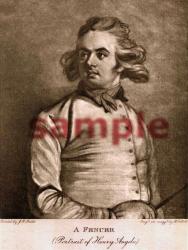
Henry Angelo

Henry Angelo
Portrait by J.R. Smith and engraved by B.F. Scott.

Henry Angelo
Henry Angelo was the son and successor of Domenico Angelo Tremamondo, the most famous swordsman and teacher of swordsmanship in England during the 18th century.

Henry studied at Eaton until 1772. He then decided to follow in his father’s footsteps as a maitre d’armes and traveled to Paris to study the art of fencing. He received his technical training at the salle d’armes of M. Motet who had earned the reputation of being the finest fencing master in Paris at that time. Henry received his degree of maitre d’armes and in 1775 returned to London to become his father’s principal assistant. Henry served as his father’s assistant for ten years. In 1785, on his father’s “retirement,” he assumed the position of head master of the famous school of fencing.

Return to top
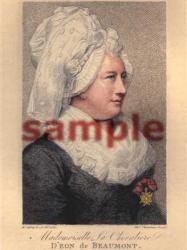
Chevalier D’Eon de Beaumont

Chevalier D’Eon de Beaumont
Portrait by R. Cosway, R.A., and engraved by Thomas Chambers

Chevalier D'Eon de Beaumont
D’Eon was considered one of the best swordsmen of France though his gender was a source of speculation until his death.

Charles Genevieve Louis Chevalier D’Eon de Beaumont. D’Eon studied fencing and horsemanship under Monsieur Taillagori and Monsieur Gueriniere respectively, alongside Domenico Angelo Tremamondo in Paris. He became a diplomat and spy, was appointed a member of the elite Dragoons, and for sometime he was a Freemason. At some point in his career he adopted female guise and attire (which he continued to do for the rest of his life) in order to facilitate his espionage. The Chevalier was sent to London as a diplomat and while there was a frequent visitor to Angelo’s home and Academy. D’Eon was considered one of the best swordsmen of France though his gender was a source of speculation until his death.

Return to top
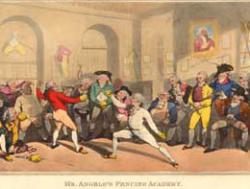
Angelo's Haymarket fencing academy

Angelo’s Haymarket fencing academy
Painted by T. Rowlandson

Angelo's Haymarket fencing academy
In this famous scene one can observe a typical 18th century school of fencing in full operation.

Mr. Angelo’s fencing academy was located at the opera house at Haymarket in London. It remained at that site for many years until it was destroyed by fire on June 17th, 1789 and subsequently closed. The academy was reopened at No. 13 Bond Street, London where it remained for thirty years. In this famous scene one can observe a typical 18th century school of fencing in full operation. In the center of a room crowded with spectators and fencers one can see Henry Angelo fencing with one of the students of the academy. To the far right Domenico Angelo - Henry’s father and head master of the academy - can be seen wearing a plastron and holding three foils in his arm while standing next to a seated gentleman. On the upper right there is a portrait of the famous swordsman the Chevalier De Saint-George. Along the walls there are racks holding foils, padded practice sleeves, crossed single sticks and a variety of picture frames containing various illustrations of fencing techniques.

Return to top
Madame Collie of Rome fencing at Angelo's academy

Madame Collie of Rome fencing at Angelo’s academy
Painted by T. Rowlandson

Madame Collie of Rome fencing at Angelo's academy

In this painting, Angelo's fencing academy is depicted on the occasion when Madame Collie of Rome came to participate in the fencing in 1816. This academy, which was located on No. 13 Bond Street, London was the successor to the original academy located at the Opera House in Haymarket London that was destroyed by fire on June 17, 1789.

Return to top
The Assault between Saint-George and D'Eon

The Assault between Saint-George and D’Eon
Painted by Robineau and engraved by V.M. Picot.

The Assault between Saint-George and D'Eon

A depiction of the famous “assault” between two of the most famous swordsmen of the 18th century, namely the Chevalier de Saint-Georges and the Chevalier D'Eon. This encounter took place on April 9th 1787 at Carlton House and was witnessed by the Prince of Wales and other nobility.

Return to top
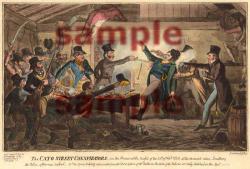
The Cato Street Conspirators

The Cato Street Conspirators
Painted by George Cruikshank and published on March 9th 1820 by G Humphrey No. 27t St James&rsqip;s Street London

The Cato Street Conspirators
‘The Cato Street Conspirators, on the memorable night of the 23rd of February 1820, at the moment when Smithers the Police officer was stabbed; NB the Scene faithfully represented from the Description of Mr. Ruthven, the View of the Interior correctly sketched on the Spot’

The Cato Street conspiracy was a plan to overthrow the British government. This painting depicts the affray between police officers and approximately 20 conspirators who were meeting at a hayloft on top of a house on Cato Street. Shown in this painting is the violence and ferocity of such a brawl. The fatal stabbing of police officer Smithers by a man wielding a small sword is the most prominent fixture of this painting. Among the various types of weapons that can be seen in this painting are muskets, pistols, sabres and a hand held bayonet.

Return to top
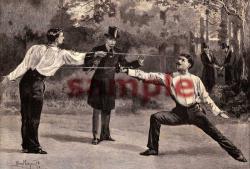
Duel with Epees 1899

Duel with Epees 1899
Drawn by Percy Macquoid. RI

Duel with Epees 1899
This drawing depicts a “stop” hit by rassemblement which is counter offensive technique used to counter attack as the adversary’s lunges.

This engraving appeared in the Graphic, a British newspaper published in 1889. It was the first daily-illustrated newspaper. This illustration, published on January 7th, 1899, is the last of a series of six engravings on the history of dueling with swords.

This drawing depicts a “stop” hit by rassemblement which is counter offensive technique used to counter attack as the adversary’s lunges. It is executed by extending the sword arm, directing the point of the sword at the adversary’s face while bending slightly at the waist and withdrawing the lead foot to bring the heels of both feet together forming a right angle thus bringing the body back away from the adversary's on coming point. Properly executed, the adversary will be struck by the point before his attack terminates.

Return to top
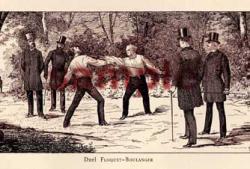
Duel Floquet-Boulanger

Duel Floquet-Boulanger
An engraving published in 1892

Duel Floquet-Boulanger

This image of the late 19th century affair of honor between General Boulanger and the lawyer Floquet, who was much older than the General, portrays the moment in which Floquet thrust his sword into Boulanger's neck. It later became known that the General had no knowledge of swordsmanship.

Return to top
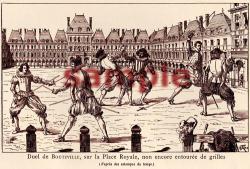
Duel de Bouteville

Duel de Bouteville
A 1892 print

Duel de Bouteville
This 19th century engraving depicts the duel that took place on May 12,1627 at three o’clock in the afternoon between the Comte François de Montmorency-Boutville and the Marquis de Beuvron on a outdoor square in the Place Royale.

The Comte de Bouteville was a French nobleman in the court of Louis XIII who was a notorious and unrepentant duelist. Bouteville fought twenty-two duels between the ages of fifteen and twenty-eight. During this era it was the custom in an affair of honor for the seconds to join in the combat along with the two principles. On this occurrence Bouteville was seconded by his relative the Count de Rosmadec and Sieur de la Berthe. Beuvron brought his esquire whose name was Choquet and the Marquis de Bussy d’Amboise. The combat was ferocious and brief. Bouteville and Beuvron fought each other to a standstill and spared each other’s life without injury. Bussy died from a wound to the jugular vein, La Berthe was wounded, Choquet escaped to England with the principle Beuvron, while Rosmadec was later arrested along with Bouteville and thrown in the Bastille. Shortly thereafter, both Bouteville and Rosmadec were executed for violating the King’s edicts against dueling.

Return to top
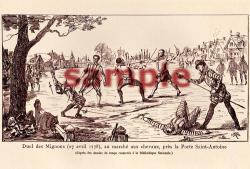
Duel des Mignons

Duel des Mignons
A 1892 print

Duel des Mignons
This 19th century engraving depicts one of the most famous duels in French history. Taking place on April 27, 1578 during the reign of Henri III and known as the Duel des Mignons, it was one of the instances where the savage nature inherent in armed combat manifests itself within the context of a duel.

Mignon is a term meaning a favorite of the King. In this case two of Henri III Mignons, Quelus and d’Entraguet developed an animosity towards each other over their amorous interest in a lady. Maugiron and Livarot seconded Quelus, while his selected assistants Riberac and Schomberg seconded d'Entraguet. During this era it was the custom in an affair of honor for the seconds to join in the combat along with the two principles.

In the furious rush of the combatants the seconds Riberac and Maugiron died of sword thrusts through the body. The other pair of seconds engaged with each other and Schomberg severely opened up the cheek of Livarot with a horrible cut. The latter, however, ran Schomberg through the chest and killed him instantly. The principles Quelus and Entraguet engaged with vigor, the former armed with a rapier and the latter with a rapier and dagger. In the first exchange Entraguet received a slight thrust to the arm and the hand of Quelus was severely mangled. As the fight progressed, Entraguet, in making use of the rapier and dagger, stabbed his adversary several times in the body and Quelus fell from exhaustion and loss of blood. On falling Quelus asked Entraguet to be satisfied and the combat stopped. However, some weeks later Quelus the King's favorite died of his wounds. Henri III was so angered and stricken with grief that he forbade all dueling in his realm on pain of death.

Return to top
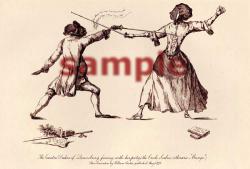
Soubise and the Duchess of Queenbury

Soubise and the Duchess of Queenbury
An illustration by William Austin, 1773

Soubise and the Duchess of Queenbury

This engraving depicts Soubise imparting fencing instruction to the Duchess of Queensbury. Soubise (originally named Mungo) was the black servant and page of the eccentric Duchess of Queensbury. The Duchess sent him to Angelo’s fencing academy in London where he was trained and developed considerable skill in swordsmanship and eventually became a fencing instructor in the employ of Mr. Angelo. Unfortunately, due to his personal excesses and indiscreet behavior, Angelo was placed in the position of having to dismiss him from the Academy. Soubise was compelled to go to India where he opened a successful fencing and riding school in Bengal. Later, he was instantly killed upon falling from an extremely aggressive Arabian stallion.

Return to top
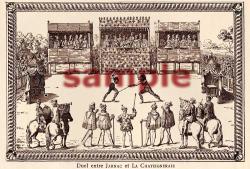
Duel between Jarnac and Chateigneraie

Duel between Jarnac and Chateigneraie
A 1892 print

Duel between Jarnac and Chateigneraie
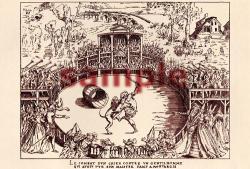
This 19th century engraving depicts what is arguably one of the most famous “duels” in history. Taking place in France on July 19, 1547 during the reign of Henry II, this formal combat is unique in that it is considered by dueling historians as the last of the formal “Chivalric duels” or “trial by combat”. The encounter between the aggrieved parties took place on a champ clos (closed field) a pre-selected and designated area.

This formal combat between Guy Chabot Comte de Jarnac (Jarnac) and Francois de Vivonne Seigneur de Chateigneraie (La Chateigneraie) who were both kinsmen and neighbors resulted from an accusation that Jarnac was being “kept” by his father’s second wife. Chateigneraie held to the position that Jarnac told him that he had a liaison with his stepmother. Jarnac, upon hearing of this accusation, gave Chateigneraie “the lie,” meaning that Chateigneraie was a liar. Jarnac demanded that his honor be restored and Chateigneraie accepted the challenge, requesting a “field” from the King. Francis I at first granted the request only to afterwards withdraw it. Upon the death of Francis I, Chateigneriae petitioned King Henri II for a field and Henri II granted the request. The sovereign decided that the combat would take place in thirty days, both gentlemen having a month in which to prepare for the ordeal. La Chateigneriae was an experienced warrior and was renowned as a man at arms. On the other hand Jarnac was ten years younger and inexperienced. He therefore enlisted the services of an Italian fencing master.

On the appointed day after all of the formalities and ceremony were completed, the men entered the field. Upon the signal to commence, they quickly advanced and met each other, giving and receiving many blows and several inconsequential wounds. Jarnac, adhering to his fencing-master's teachings, executed a high feint at Chateigneraie’s head. As Chateigneraie raised his buckler to defend, Jarnac passed his blade under the defending shield and gave a cut to the ham of Chateigneraie’s left leg behind the knee. Jarnac pursued the attack and followed with an immediate cut to the ham of the right leg. From that moment this technique became known as the coup de Jarnac.

Chatiegneraie fell but vainly attempted to continue the combat only to be disarmed. Jarnac, not wishing to take advantage and desiring not to kill his adversary, pleaded with King Henri II several times for a decision. However, the King did not utter a word. After repeated pleading the king was advised to have Chateigneraie’s wounds attended to but Chateigneraie feeling utterly disgraced, refuses treatment and died from the loss of blood.

Return to top
Combat between Man and Dog

Combat between Man and Dog
A 1892 print

Combat between Man and Dog
A 19th century engraving depicting one of the strangest “duels” of all time between a man and a dog. Taking place in 1400 it falls into the category of a “trial by combat”.

The circumstances surrounding a murder led to this curious encounter between man and beast. The slain victim was Aubruy de Montdidier who was murdered by his “friend”, Chevalier Maquer in a forest outside of Paris, France. The only witness to this crime was Montdidier’s large dog. Maquer buried the body in the presence of the dog. The dog remained at his master’s shallow grave until forced by hunger he went to the home of Chevalier Ardilliers, a friend of his master, to beg for food. Ardilliers noticed that there was something wrong with the dog as it wined and whimpered. The dog eventually compelled Ardilliers to follow him into the forest where the animal led his master’s friend to discover the grave. Ardilliers and his servants dug up the corpse. Sometime later when walking on the street Ardilliers and the dog met Maquer and the dog attacked him with such ferocity that it took several men to pull him off. It was unusual behavior for the dog, as it was known that the beast was of a tranquil and pacific temperament. This occurred again on several separate occasions, which gave rise to suspicion from many people. Finally, all was reported to the King. The monarch made the decision that the guilt or innocence of Maquer was to be decided by a trial by combat in which dog and man were to be the principles.

The combat took place on the Isle of Notre-Dame. The dog was led into the lists by Ardilliers were he was loosed upon Maquer. There is more than one account of what transpired but this engraving depicts Maquer armed with a stick to defend himself against this large dog. The stick being an insufficient weapon of defense, the dog attacked savagely and seized Maquer by the throat. Maquer reportedly screamed that if the dog were pulled away that he would confess to the crime. Maquer was hanged for the murder that he committed..

Return to top
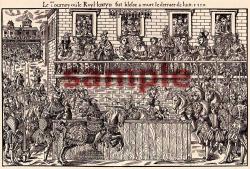
The Fateful Tournament of Henry II

The Fateful Tournament of Henry II
An early French woodcut

The Fateful Tournament of Henry II

This print captures the tragic moment in the 1559 tournament in which Henri II King of France participated when he was mortally wounded by a lance that passed through the opening in the visor of his helmet. The woodcut image shows the lance shattering on impact resulting in its end entering the Kings cheek under the left eye. Henri II lingered in pain for ten days until he died from the injury he suffered.

Return to top